
By Rev. Fr. Petros Mwale (Mzuzu Diocese – MALAWI)
INTRODUCTION
Fr. Petros, the Catechism no 974 clearly states: “The Most Blessed Virgin Mary, when the course of her earthly life was completed, was taken up body and soul into the glory of heaven, where she already shares in the glory of her Son’s Resurrection, anticipating the resurrection of all members of His Body.” Is there any evidence that Mary was taken to Heaven “body and soul” upon her death, since the Bible seems to be silent about it? – Teresa (Nurse – Rumphi District Hospital, MALAWI).
Remember to link my Facebook page for the latest Catholic Doctrines, click here https://m.facebook.com/story.php?story_fbid=190197852457239&id=109027757240916
RESPONSE
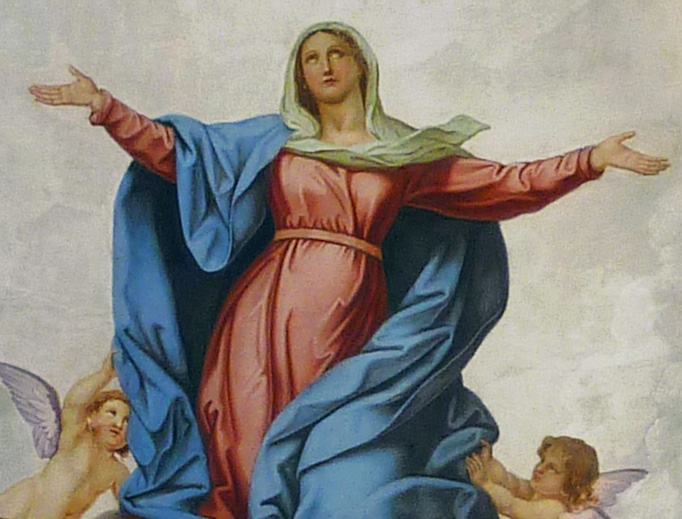
Dear Teresa, on 1st November 1950, Pope Pius XII in his Apostolic Constitution called Munificentissimus Deus (the most Bountiful God) defined the Assumption of the Blessed Virgin Mary as quoted in your question. Let us prove this historically and biblically.
HISTORICAL EVIDENCE
A. THE TWO CITIES
We know that after the crucifixion Mary was cared for by the apostle John (Jn 19:26-27). Early Christian writings say John went to live at Ephesus and that Mary accompanied him. There is some dispute about where she ended her life, perhaps there, perhaps back at Jerusalem. Neither of these cities nor any other claimed her remains, although there are claims about possessing her (temporary) tomb. Why did no city claim the bones of Mary? Apparently because there were no bones to claim, and people knew it.
B. THE EARLY MARTYRS
Remember, in the early Christian centuries, relics of saints were jealously guarded and highly prized. The bones of those martyred, for instance, were quickly gathered up and preserved; there are many accounts of this in the biographies of those who gave up their lives for the faith (for example, the bones of St. Peter and St. Paul were widely known to be preserved in Rome, and the sepulcher of David (1 Kings 9:28) and the tomb of St. John the Baptist (Mt. 14:12) are both mentioned in Scripture). Yet here was Mary, certainly the most privileged of all the saints … but we have no record of her bodily remains being venerated anywhere.
C. LETTER OF JUVENALIUS TO EMPRESS PULCHERIA
Explicit mention of the Assumption of Mary begins to appear in 4th century. We have an account of the event given by St. John Damascene in a copy of a letter he preserved from a fifth century Patriarch of Jerusalem named Juvenalius to the Byzantine Empress Pulcheria. The Empress had apparently asked for relics of the most Holy Virgin Mary. Patriarch Juvenalius replied that: in accordance with ancient tradition, the body of the Mother of God had been taken to Heaven upon her death, and he expressed surprise that the empress was unaware of this fact (implying that it must have been more or less common knowledge in the Church at the time).
D. THE EVENT PROPER
Juvenalius joined to this letter an account of how the apostles had been assembled in miraculous fashion for the burial of the Mother of God, and how after the arrival of the apostle St. Thomas, her tomb had been opened, and her body was not there, and how it had been revealed to the apostles that she had been taken to Heaven, body and soul. Later, in the sixth century, belief in the Assumption was defended by St. Gregory of Tours, and no saint or father of the Church thereafter disputed the doctrine.
BIBLICAL EVIDENCE
There is an allusion to the mystery of the Assumption, in the writings of the Apostle St. John, the one into whose care our Lord placed His Mother at the hour of His death on the Cross (Jn 19:26-27), and especially in what may be the last of the New Testament books to be written, a book almost certainly written after Mary’s earthly life was over, the Book of Revelation.
Remember, the old Ark of the Covenant had been lost for many centuries, and none of the Jews knew where it could be found. (Indeed, it remains missing to this very day). With that in mind, look at what we find in Rev 11:19:
“Then God’s temple in heaven was opened, and the ark of His covenant was seen within His temple, and there were flashes of lightening, voices, peals of thunder, an earthquake and heavy hail.”
Wow, what an audio-visual spectacular! The Ark had been found! But look at Rev. 12:1-2:
“And a great portent appeared in heaven, a woman clothed with the sun, with the moon under her feet, and on her head a crown of twelve stars; she was with child. … she brought forth a male child, one who is to rule all the nations with a rod of iron.”
Here the Ark of the Covenant is associated with the apparition of a glorious woman. Likewise in Luke 1:43-45, Mary is associated with the Ark of the Covenant, since her cousin Elizabeth greets her with almost the same words used by David when the Ark came to him (2 Samuel 6:9, 14). Pius XII also quotes Psalm 132:8, which has often been read symbolically of Mary’s Assumption: “Arise, O Lord, into your resting place: you and the ark, which you have sanctified” (MD no. 26).
CONCLUSION
The Assumption of the Blessed Virgin is a singular participation in her Son’s Resurrection and an anticipation of the resurrection of other Christians: In giving birth she kept her virginity; in her Dormition she did not leave the world, O Mother of God, but was joined to the source of Life. She conceived the living God and, by her prayers, she will deliver our souls from death.
Receive my Priestly Blessings from St. Cecilia Catholic Parish (Mzuzu Diocese – Mpherembe)
Rev. Fr. Petros Mwale – Feedback: +265884150185 (WhatsApp only)
SOURCES
Pope Pius XXI, Apostolic Constitution, Munificentissimus Deus – Defining the Dogma of the Assumption, Acta Apostolicae Sedis: Vol XXXXII (1950) pp. 753-773.
Tavard, George H., The Thousands Faces of the Virgin Mary, Collegeille Minnesota: Michael Glazier Books, 1996.
Catechism of the Catholic Church, 2nd ed. Washington DC: United States Catholic Conference, 2000

 Catholic Doctrines